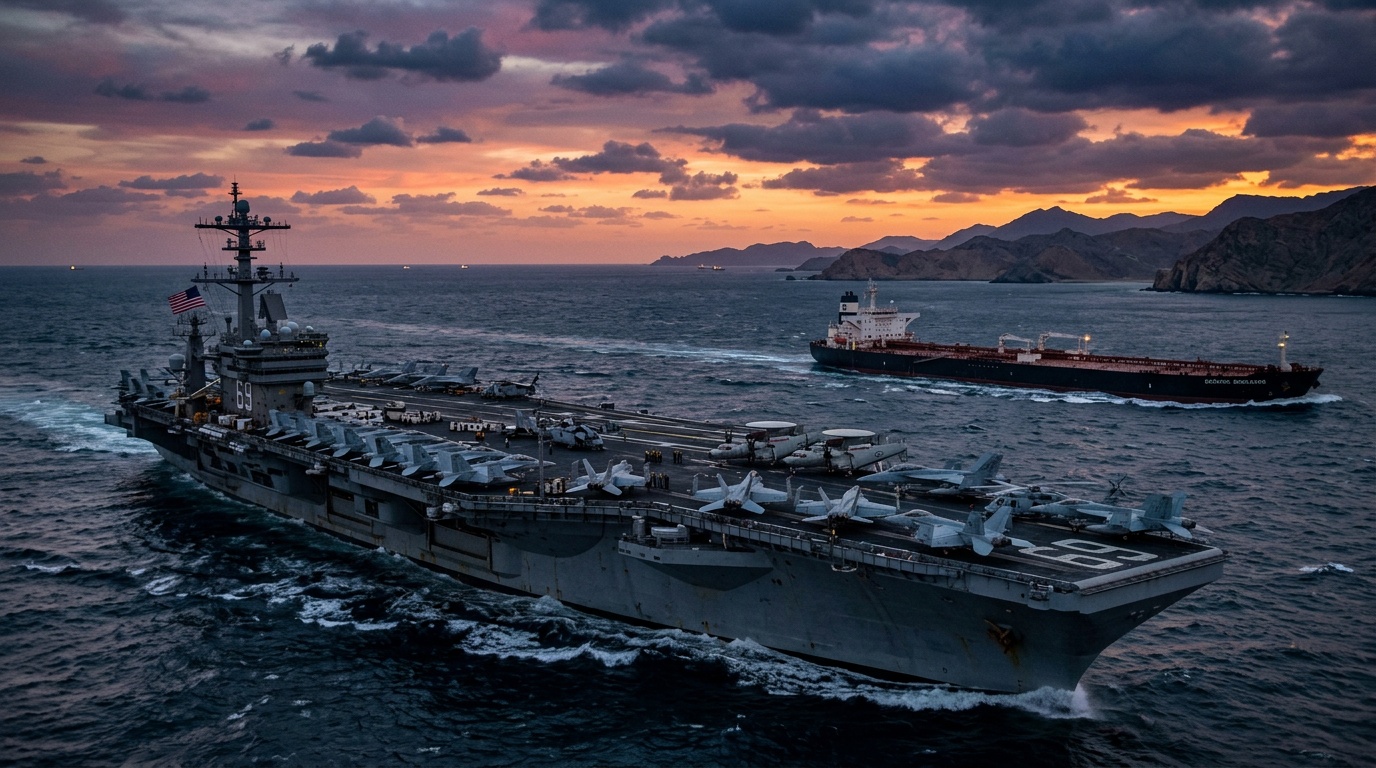
Here's a story that sounds like it's straight out of a spy novel, but it's actually happening right now in the Strait of Hormuz. The U.S. military has reportedly set up a "stealth" shipping corridor in one of the world's most critical oil chokepoints, and it's moving a staggering amount of crude.
According to a report from Axios, the operation has been running for weeks. Every night, 15 to 20 tankers slip through the strait using a southern channel along Oman's coast. Together, they're hauling roughly 10 million barrels of oil per day into the global market. That's about half of the pre-war volume that used to flow through this waterway.
How is this possible? The report says a recent two-week campaign by U.S. Central Command (CENTCOM) took out much of Iran's radar and maritime surveillance capabilities. That has seriously limited Tehran's ability to keep an eye on what's moving through the southern channel.
But the U.S. role isn't just about escorting loaded tankers out. They're also helping empty tankers get into the Gulf from the Arabian Sea, pick up oil from regional producers, and then make their way back out. The task force coordinating all this is based at Fort Bragg, North Carolina, and works with Gulf partners to track daily ship movements through the strait and into the Arabian Sea.
A U.S. official put it bluntly: "We have been controlling the southern lane of the Strait of Hormuz for two months now. The Islamic Revolutionary Guard Corps (IRGC) can be a nuisance, but they don't control the strait. We do."
The Pentagon didn't immediately respond to requests for comment, but the implications are huge.
Analyst Sees Major Supply Impact
GasBuddy analyst Patrick De Haan weighed in on the news, calling it "a major development if accurate." When asked whether the volume of oil moving through the corridor is enough to move the needle on global supply, he said it's "more than what is being released via the SPR pretty easily." He also noted that the market has "little data" on this yet.
This comes as the U.S. Strategic Petroleum Reserve (SPR) drawdown is expected to wrap up in September, with reserves likely staying above 275 million barrels. A previously authorized 172-million-barrel release is nearly complete.
Oil prices are reacting to the news. Brent crude futures were up 2.63% at $94.04 per barrel, while WTI crude futures climbed 2.80% to $88.23 per barrel.
Trump Says Iran Talks Are a Waste
The situation in the strait is shifting the balance of power in the region. Analysts say the U.S. is gaining control while Iran's influence fades. The U.S. Navy has been patrolling the strait, and more than 80% of liquid transits in the past two weeks have taken the Omani route. Despite the risks, most ships are ignoring Iran's demands and crossing under American protection.
President Trump told Axios that the U.S. isn't negotiating with Iran right now, calling talks a "waste of time." He pointed to the "tremendous amount" of oil flowing through the strait as evidence that the pressure is working. "The Iranians still have some fight left, but overall they are a shell of themselves," he said.
So, what does this mean for oil markets? If the corridor is indeed moving 10 million barrels a day, that's a significant chunk of supply that the market may not have fully priced in. It could help offset some of the supply concerns that have been driving prices higher. But as De Haan notes, there's still a lot of uncertainty. For now, the world is watching to see if this covert operation holds and what it means for the global energy landscape.